Porcelain, LVP or engineered wood: choosing a floor that lasts
A floor is chosen from a sample held in the hand and judged years later underfoot. The properties that decide how it ages — substrate, moisture and traffic — are the ones a sample cannot show you.
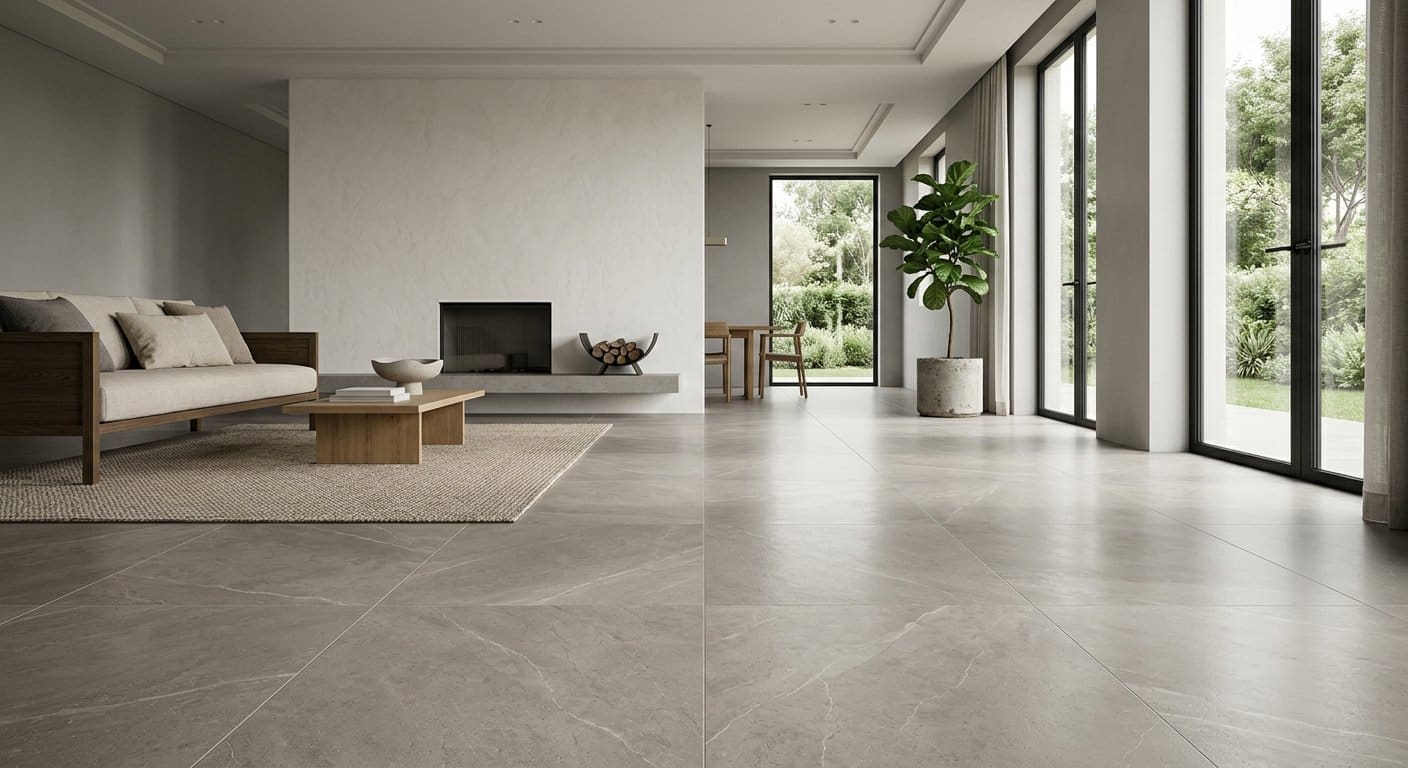
Flooring is the finish most often selected on appearance alone, and the one where appearance tells you least about how it will perform. The sample in the showroom is flat, clean, dry and unloaded. None of those conditions describe the floor you are about to install.
The substrate decides more than the finish
Most flooring complaints we are asked to inspect are substrate problems wearing the surface as a disguise. Hollow-sounding tiles, lipped edges between planks, cracked grout lines and loose boards are usually traceable to a screed that was not flat enough, not dry enough, or not clean when the adhesive went down.
Every flooring type has a flatness tolerance, and thinner, harder materials are less forgiving. Large-format porcelain in particular will telegraph an uneven screed, because a rigid tile cannot follow a curve. Correcting the substrate is unwelcome and cheap. Lifting a finished floor is neither.
Moisture matters just as much. A new concrete slab holds water for far longer than a programme usually allows, and sealing a slab under an impermeable finish traps it. Where a slab is young or ground-bearing, the moisture state should be established before the finish is chosen, not after the adhesive fails.
Porcelain and ceramic
The practical difference is water absorption. Porcelain is fired denser and absorbs very little, which makes it dimensionally stable, frost-resistant and suitable for wet areas and outdoors. Ceramic is more porous, softer and generally cheaper, and is well suited to walls and light-traffic interior floors.
For floors, check the abrasion rating rather than the price. A tile intended for walls or light domestic use will dull visibly in a hallway or a commercial entrance. Rectified tiles — mechanically ground to a precise edge — allow narrow joints and a cleaner field, but they demand a flatter substrate and better workmanship, so they are not automatically the better choice.
Luxury vinyl plank
With LVP the number that matters is the wear layer: the clear film above the printed design. It, and not the total thickness, determines how long the floor keeps its appearance. A thick plank with a thin wear layer feels substantial and wears through early.
LVP is comfortable underfoot, quiet, and tolerant of moisture from above, which makes it a sound choice for bedrooms, offices and light commercial areas. Its weakness is heat. Vinyl expands and contracts with temperature, so planks in a room with strong direct sun can move against the perimeter. Glue-down installation controls this better than a floating click system, and expansion gaps are not optional.
Engineered wood
Engineered wood gives real timber on a stable plywood core, which is what allows it to be used in humid conditions where solid timber would be unwise. The specification to check is the thickness of the top wear layer, because that determines whether the floor can be sanded and refinished later — the property that separates a floor with a long second life from one that must be replaced.
Acclimatisation is genuinely necessary rather than a formality. Boards should sit in the room in which they will be laid, in the conditions in which they will live, long enough to reach equilibrium. Installing a pallet delivered that morning is the reliable way to produce gaps in a few months.
Matching floor to room
- Wet rooms, kitchens and outdoor areas: porcelain, with slip resistance appropriate to a wet surface rather than a dry showroom.
- Entrances and circulation: porcelain with a high abrasion rating. These areas take grit from outside, which is what actually abrades a floor.
- Bedrooms and offices: LVP or engineered wood, chosen for comfort and quiet.
- Living areas with strong direct sun: prefer glue-down LVP or engineered wood over floating systems, and expect some colour change over time.
- Light-traffic walls and features: ceramic remains the sensible economy.
What “supply and install” actually includes
The phrase is used as if everyone already agrees what it covers. They do not. The surprises are almost never the product — they are access, making-good, storage, waste, and who owns the substrate when something is not square.
Choosing finishes for Accra humidity and harmattan dust
Ghanaian interiors fail in two seasons for two different reasons: moisture that never quite leaves, and dust that arrives all at once. The finish that looks right on a sample board is not always the one that still looks right in March.
Choosing between SPC, WPC and fluted wall panels
The three panel families look similar on a sample board and behave very differently on a wall. What actually separates them is the core, and the core decides where each one belongs.
Planning something along these lines?
Send drawings, a room schedule, or photographs of the space. We will tell you what it needs and what it costs.
Get a consultation